GENDER insights
GENDER insights
When men care, households win: advancing gender equity through shared responsibilities and male engagement
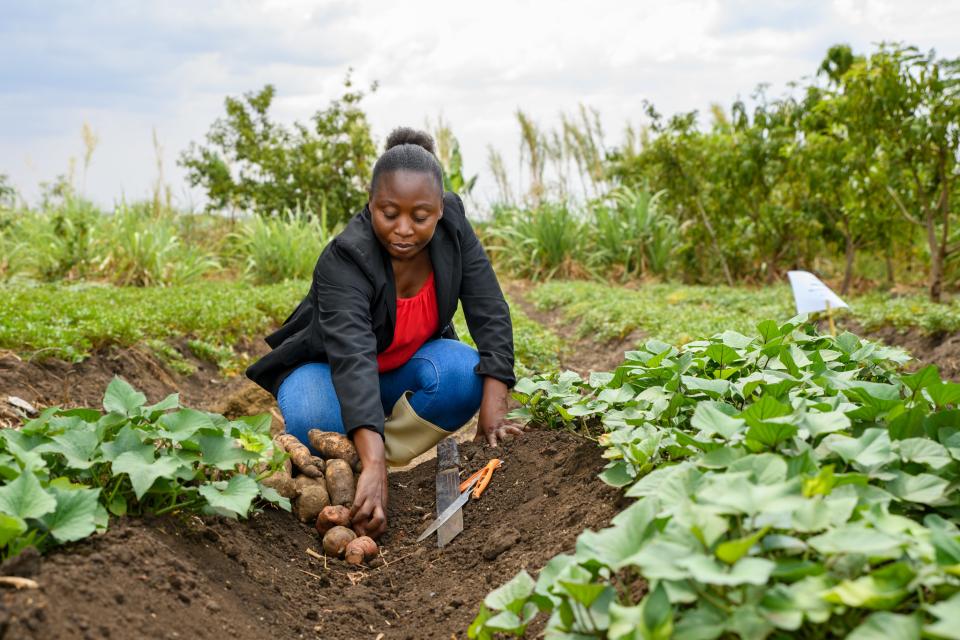
 Photo: N.Ronoh/CGIAR
Men’s participation in care work such as domestic labor and looking after children and elderly people can be increased through conversations and storytelling within homes and communities. Increased participation in care work results in improved family relationships and sense of well-being; higher productivity, savings and income; and more sustainable livelihoods and food systems.
“When Men Care: Transforming Gender Norms for Inclusive, Resilient Rural Communities” was a session held during the recent Gender in Food, Land and Water Systems 2025 conference. The organizer and chair of the session, Jessica Cadesky [researcher, International Development Research Centre] opened the session by describing the issue:
“We know that women and girls shoulder a disproportionate amount of unpaid care work… which includes direct care provided to children, the elderly and people with disability and illness, but it also includes domestic work and supervision. Women and girls globally… work on average three times more on unpaid care work than men… so we are asking ‘where do men fit into this picture?’”.
Participants attending the session heard about three African case studies that highlighted the urgency of recognizing, reducing and redistributing care work between men and women. The first speaker, Josée Ntabahungu [CARE Burundi] outlined the “Belle Colline” or beautiful hill approach being taken in Burundi. Nelly Njiru [researcher, International Livestock Research Institute] spoke about “Innovations for Reduced and Redistributed Care Work (I4RR) in Kenya and Ethiopia”, and Ravina Pattni (Laterite, Tanzania) described integrating unpaid care discussions into Farmer Field and Business Schools.
Gender inequalities persist in care work through social and cultural norms
All three case studies demonstrated how cultural and social norms are key to determining how caregiving responsibilities are shared — and that most caregiving and domestic responsibilities are assigned to women. In Burundi, for example, Ntabahungu said women were found to be: “doing everything, fetching water, doing all the care work at home, being beaten and not considered, with the men not helping at all”.
In many instances, social norms and myths were discovered to be encouraging this burden on women. For example, in Kenya Njiru described a myth where it was thought that “if a man carries babies, they're going to lose their strength… which means when they engage in battle, the community is going to be defeated, or the men will be killed”.
The speakers noted that there was a common fear among women and men that if women were empowered then this would threaten men’s authority and could lead to a backlash, including increased gender-based violence.
The perpetuation of such inequities is not helped by the lack of institutional recognition of unpaid care work in agricultural and rural development policies. And even when policies are supportive, their implementation is irregular.
Integrate reflexive and participatory approaches
All three case studies used inclusive and participatory approaches to research or help address the issue of care and gender norms and roles. The Belle Colline approach used in Burundi sought to create a “hill worth living on for women and children”. Visual and participatory exercises sought to help couples to “see the costs of violence and what they will gain if they change”. As participants reflected on the costs of violence and gendered division of labor, they also learnt the possible benefits from women’s entrepreneurship and economic empowerment. Ntabahungu stressed that it was important to take an inclusive approach that did not assign blame, which could exclude men.
Likewise, Njiru found that change to communities in Kenya and Ethiopia is more likely to be sustainable when men are mobilized as allies through cultural tools like storytelling and theatre, which can be very powerful at shifting perceptions. Njiru’s research team undertook in-depth focus group research with separate groups of women and men. They used short stories from each group to stimulate discussions and found participants were able to talk about their issues openly and passionately. Njiru said that talking about their issues in this way led to both women and men to better understand their own situations, which was a critical finding for the data collectors.
In another example, an unpaid-care module was integrated into the Farmer Field and Business Schools in Tanzania, it was deliberately co-designed with local communities to reflect their own lived experiences. According to Pattni, the module’s design reflected their finding that while men individually supported being more involved in care work, their motivation to do so was suppressed by their concern about external social pressures.
Apply local contexts and evidence
Speakers and participants in the session discussed the importance of understanding local contexts for designing interventions. This means avoiding “copy–paste solutions” and instead tailoring approaches to local realities, languages and household structures. It requires understanding the norms, institutions and environments within which families and communities operate rather than applying a one-size-fits-all model.
In describing the Belle Colline approach, Ntabahungu explained that successful application of the model depended on “taking into account the ecosystem of the area where we are working… we adapt each time but keep the DNA of that approach”. Each village or “colline” faces distinct challenges – water scarcity, lack of authority buy in, or social tensions – and interventions are adjusted accordingly. Every intervention must also align with existing local structures, particularly administrative hierarchies and community actors.
Similarly, Pattni stressed that in Tanzania, they “used baseline results and findings to fine-tune the existing models” to fit the local social and agricultural conditions.
With the I4RR program in Kenya and Tanzania, such adaptation meant grounding interventions in identified local gender norms to help shift thinking around unpaid labor in livestock and fodder systems. Njiru explained: “There is a norm that men cannot go to fetch water carrying water cans on their heads or with bags. That has helped [drive] the technological innovation of using donkeys, whereby the men are now helping their wives in fetching water using donkeys. They are also fetching firewood.” The extra time that women gain through this help has allowed them to engage in income-earning activities such as vegetable farming. “Women are now using that income to purchase food, pay school fees and meet family needs,” said Njiru.
Sustaining and scaling-up change
The speakers and participants in this session agreed that sustainability for interventions comes from embedding them within formal systems. In Tanzania, Laterite collaborated with the Sokoine University of Agriculture and the Ministry of Agriculture to integrate the unpaid care work module into the Farmer Field Business School curriculum, ensuring the model could persist beyond project funding. As Pattni explained, this “vertical institutionalization…enforces the sustainability of the project”.
Sustainability usually also means strengthening networks and agency beyond a single organization to include formal and informal actors, including local administrators, religious leaders, young people, community leaders and local champions. Research and practice need to be brought together through collaboration between gender centers, universities, ministries and community organizations.
Interventions are best sustained with local ownership and leadership. The Belle Colline approach requires that it “be driven by women…locally led…and inclusive”. Ntabahungu explained: “We continue searching, we continue learning and adapting. It’s a dynamic approach [that seeks] to have a community which has changed, because if there is no mindset change, you cannot have a lasting change.” There is a ripple effect beyond households of peer influence, “When a few men change, others will follow.”
The three case studies presented and discussed factors leading to long-term success. “We see the gender transformative approaches are actually working on the mindset change, whereby the myths, the stereotypes, the norms, are starting to relax,” said Njiru.