Melo Molina, Elsa Liliana; Ortega Ojeda, Carlos Alberto; Gaigl, Andreas; Bellotti, Anthony C.; Ehlers, Ralf-Udo; Susurluk, Alper. 2004. Búsqueda de poblaciones nativas de nematodos entomopatógenos en regiones de Colombia y Panamá . Centro Internacional de Agricultura Tropical (CIAT), Cali, CO. 1 poster.
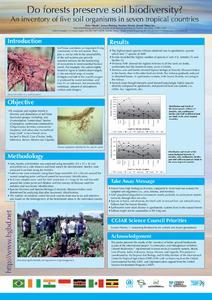
Okoth, Peter F.; Huising, Jeroen; Ichami, Stephen; MungŽatu, Joseph. 2008. Do forests preserve soil biodiversity? : An inventory of five soil organisms in seven tropical countries. Centro Internacional de Agricultura Tropical (CIAT), Tropical Soil Biology and Fertility (TSBF), Nairobi, KE. 1 p.
Camargo, Cilas Pacheco; Bragantini, Claudio; Aguirre, Roberto; Garay, Adriel E.; Fernández de Soto, José. 1989. Seed for small farmers : Support infrastructure. Centro Internacional de Agricultura Tropical (CIAT), Cali, CO. 39 p.
Debroux, L., Hart, T., Kaimowitz, D., Karsenty, A., Topa, G., eds. 2007. Forests in post-conflict Democratic Republic of Congo: analysis of a priority agenda . Bogor, Indonesia, CIFOR, The World Bank, CIRAD. xxii, 82p. ISBN: 979-24-4665-6..
Sheil, D., Boissiere, M., Beaudoin, G.. 2015. Unseen sentinels : local monitoring and control in conservation's blind spots. Ecology and Society, 20 (2) : 39. http://dx.doi.org/10.5751/ES-07625-200239
Angelsen, A., Brockhaus, M., Kanninen, M., Sills, E., Sunderlin, W.D., Wertz-Kanounnikoff, S., (eds.) 2010. Mewujudkan REDD+: strategi nasional dan berbagai pilihan kebijakan . Bogor, Indonesia, Center for International Forestry Research (CIFOR). 366p. ISBN: 978-6-02-869325-7..
Lyimo, S., Mdurum, Z., & De Groote, H. (2014). The use of improved maize varieties in Tanzania. *African Journal of Agricultural Research*, 9(7), 643-657. https://doi.org/10.5897/ajar11.065
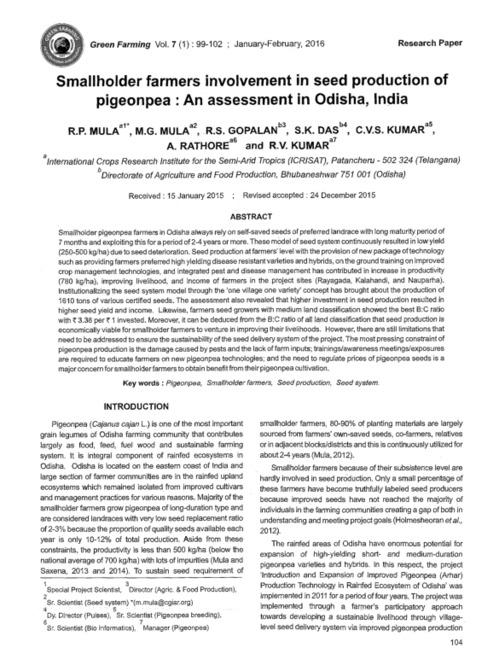
Rosana Mula, Myer G. Mula, R. S. Gopalan, S. K. Das, C. V. S Kumar, Abhishek Rathore, Ravikoti Vijaykumar. (29/2/2016). Smallholder farmers involvement in seed production of pigeonpea: An assessment in Odisha, India. Green Farming, 7 (1), pp. 99-102
Oosterom, E J Van and Bidinger, F R and Mahalakshmi, V and Rao, K P (1996) Effect of water availability pattern on yield of pearl millet in semi-arid tropical environments. Euphytica, 89 (2). pp. 165-173
Snapp, S and Kanyama-Phiri, G and Kamanga, B and Gilbert, R and Wellard, K (2002) Farmer and researcher partnerships in Malawi: developing soil fertility technologies for the near-term and far-term. Experimental Agriculture, 38 (4). pp. 411-431
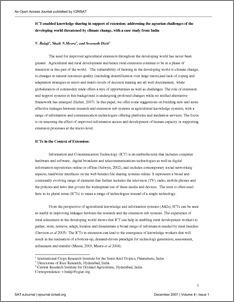
Balaji, V and Meera, N and Dixit, S (2007) ICT-enabled knowledge sharing in support of extension: addressing the agrarian challenges of the developing world threatened by climate change, with a case study from India. Journal of SAT Agricultural Research, 4 (1). pp. 1-18
Mukhopadhyay, R and Reddy, P S and Pallela, R and Reddy, N C and Rao, J V and Hash, C T and Kavi Kishor, P B (2007) Differential Responses of Proline, Ion Accumulation and Antioxidative Enzyme Activities in Pearl millet (Pennisetum glaucum (L.) R. Br.) lines Differing in Salt Sensitivity. Journal of Plant Biology, 34 (3). pp. 185-192. ISSN 0972-3862
Mallikarjuna, N and Saxena, K B and Lakshmi, J and Varshney, R K and Srikanth, S and Jadhav, D R (2012) Differences between Cajanus cajan (L.) Millspaugh and C. cajanifolius (Haines) van der Maesen, the progenitor species of pigeonpea. Genetic Resources and Crop Evolution, 59 (3). pp. 411-417. ISSN 1573-5109
Akmal, M. and Pritchett, L. (2019). Learning Equity Requires More than Equality: Learning Goals and Achievement Gaps between the Rich and the Poor in Five Developing Countries. RISE Working Paper 19/028
Tull, K. (2019). Civil Documentation for Internally Displaced Persons (IDPs) in Protracted Displacement. K4D Helpdesk Report 636. Brighton, UK: Institute of Development Studies
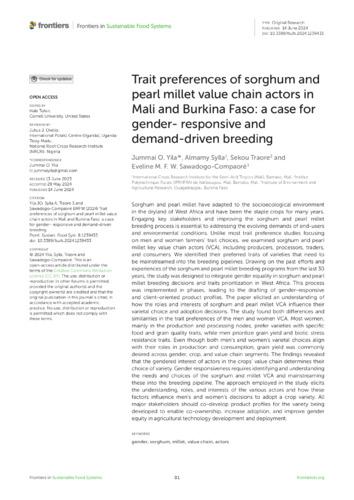
Yila, J.O., Sylla ,A., Traore, S. and Sawadogo-Compaoré, E.M.F.W. 2024. Trait preferences of sorghum and pearl millet value chain actors in Mali and Burkina Faso: a case for gender- responsive and demand-driven breeding. Frontiers in Sustainable Food Systems
Enemali, T., Awinoh, M., Lecoutere, E. 2024. Gender and climate experts come together to address inequalities and climate resilience challenges in Nigeria’s agrifood systems. Blog Article. CGIAR Initiative on Gender Equality
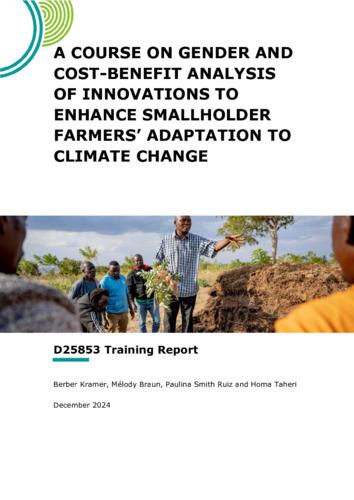
Kramer, B.; Braun, M.; Smith Ruiz, P.; Taheri, H. (2024) A course on gender and cost-benefit analysis of innovations to enhance smallholder farmers' adaptation to climate change. D25853 Training Report. 21 p. https://hdl.handle.net/10568/163607
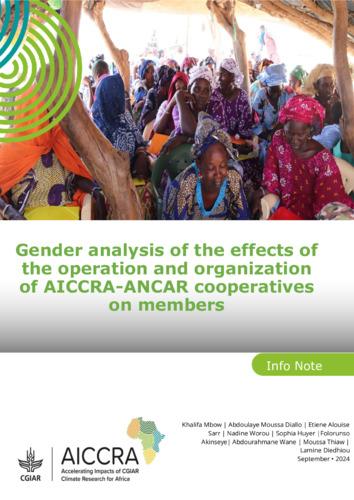
Mbow K. Diallo AM. Sarr E. Huyer S. Worou N. Akinseye F. Wane A. Thiaw M./. Diedhiou L. 2024. Gender analysis of the effects of the functioning and organization of AICCRA-ANCAR cooperatives on members. AICCRA Briefs. Accelerating Impacts of CGIAR Climate Research for Africa (AICCRA).
Lundeba, M., Kanyembo, H., Sichone, M., Kakwasha K., Mudege NN. 2024. Training workshop report: Climate-smart aquaculture, climate information services and gender training for the Aquaculture Bundle. AICCRA Report. Accelerating Impacts of CGIAR Climate Research for Africa (AICCRA).
Hidrobo, Melissa; Mueller, Valerie; Roy, Shalini; Fall, Cheikh Modou Noreyni; Lavaysse, Christophe; and Belli, Anna. 2024. Rainy day funds? How men and women adapt to heavy rainfall shocks and the role of cash transfers in Mali. IFPRI Discussion Paper 2301. Washington, DC: International Food Policy Research Institute. https://hdl.handle.net/10568/163076
Gonzales, Teresa; Kosec, Katrina; Kyle, Jordan; Madero, Ana; Mittrick, Caitlin; Myers, Emily; Quisumbing, Agnes; and Rapadas, Amica. 2024. How can anticipatory action programming support women? Application of the reach-benefit-empower-transform framework in Nepal and Nigeria. IFPRI Discussion Paper 2298. Washington, DC: International Food Policy Research Institute. https://hdl.handle.net/10568/162956
Gondwe, T., Huyer, S., Maiga, M., Bullock, R., Obeng Adomaa, F., Mujawamariya, G., Diabaté, F., Mapedza, E. 2024. Gender and Climate Smart Innovations: Lessons from the field from AICCRA and FSRP. AICCRA Report. Accelerating Impacts of CGIAR Climate Research for Africa (AICCRA).
Mukhopadhyay, P., Chadha, D., Gartaula,H.N., Puskur,R., Goel,K. 2024. Making climate-smart technologies work for women farmers: Insights from socio-technical innovation bundling (STIBs) approach in India. Presented at Tropentag 2024: Explore opportunities for managing natural resources and a better life for all. 11–13 September 2024, Vienna, Austria.
Leight, Jessica; Bahiru, Kibret Mamo; Buehren, Niklas; Getahun, Tigabu; Gilligan, Daniel O.; Mulford, Michael; and Tambet, Heleene. 2024. Promoting adoption of sustainable land management technologies by women and couples in Ethiopia: Evidence from a randomized trial. IFPRI Discussion Paper 2309. Washington, DC: International Food Policy Research Institute. https://hdl.handle.net/10568/168513
Kohli, A., Costenbader, E., and Cole, S. 2024. Gender transformative approaches in agrifood systems: A course in four modules. Module 2: Characteristics important to gender transformative approaches. Version 1. CGIAR GENDER Impact Platform and Gender Equality Initiative
Campbell, R.; Takaindisa, J.; Maviza, G. (2024) He said - she said: Reflections on gender relations at Tongogara refugee settlement. [Blog post] CGIAR news& Events. Published online 16 December 2024. URL: https://www.cgiar.org/news-events/news/he-said-she-said-reflections-on-gender-relations-at-tongogara-refugee-settlement/
Mandlenkosi, M.; Maviza, G.; Synnestvedt, T.; Caroli, G.; Makanda, J.; Gadu, S. (2024) The unseen toll of climate change in Zimbabwe: Gender, displacement, and conflict. [Blog post] CITE. Published online 19 November 2024. URL: https://cite.org.zw/the-unseen-toll-of-climate-change-in-zimbabwe-gender-displacement-and-conflict/