GENDER insights
GENDER insights
Closing the evidence gap: gender equality and food security
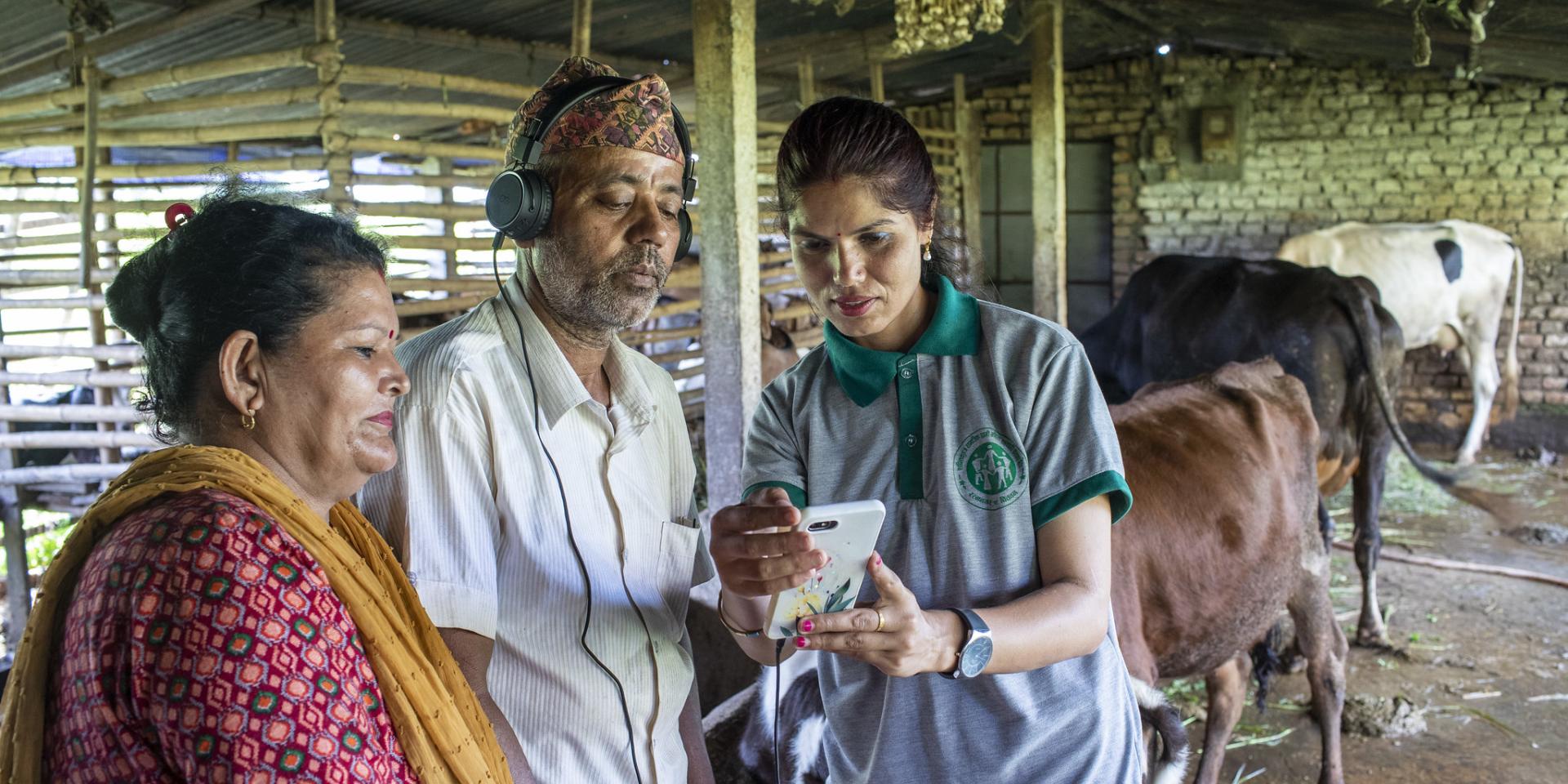
Evidence on what works for women in agrifood systems is urgently needed to drive policies and actions that transform women’s role from participation to one where they have control over their decisions, assets and climate change adaptation strategies. Food security challenges can only be met when interventions respond to women’s realities in agriculture.
The focus of a parallel session during the Gender in Food, Land and Water Systems Conference 2025 was “Strengthening evidence-informed decision-making on what works for women’s empowerment in food systems for impactful policies and actions”.
The overarching question driving the session was: How can knowledge about what works for women farmers be transformed into effective policies and practices? This inquiry was explored through five interrelated themes: identifying what works for women farmers; highlighting priorities and evidence gaps; exploring pathways from evidence to action; discussing future directions; and ensuring that discussions lead to practical actions.
Need for robust, tailored evidence for understanding women’s realities
The impact of evidence-based policymaking and action for improving food security by empowering women was illustrated by panel member, Aletheia Amalia Donald (Economist at the World Bank’s Gender Innovation Lab), discussing Zambia’s Supporting Women’s Livelihood program. The assessment of the program showed an 86 percent increase in household profits and a 126 percent increase in agricultural income. This return of US$11 for every dollar invested in the project led to further funding, including from the Zambian government.
“These impact evaluation results were used to renew the program three times—about a 400 percent increase in scale…but also something that rarely happens is the government of Zambia decided to put in from their own budget, not just the funding coming from the World Bank. So that’s an example of where accountability, trust, long-standing relationships, cost effectiveness, evidence and good timing really have a positive impact,” said Donald.
The session was opened by Etienne Lwamba, [Researcher, International Initiative for Impact Evaluation (3ie)] who stressed that understanding women and their role in agrifood systems is central to achieving food security outcomes.
“We cannot claim that we are going to address the food-security challenges or achieve the SDGs [Sustainable Development Goals] by putting women aside. They should be our priority,” he said. “Decision-makers need specific, tailored and rigorous evidence that tells them which interventions really work, so they can invest their thought and time in it.”
However, while women represent about 60 percent of the world’s food-insecure population, only 1 percent of research simultaneously investigates gender equality and food security. The panel highlighted that addressing women’s needs in agriculture was not just a gender equity issue but a prerequisite for achieving goals related to food security, better nutrition and resilience in the face of shocks such as climate change.
Drawing on multiple studies using the Women’s Empowerment in Agriculture Index (WEAI), panelist Jessica Heckart [Senior Research Fellow, International Food Policy Research Institute] highlighted that women’s empowerment, dietary diversity and child nutritional outcomes tend to move together. Where women have greater decision-making power, household nutrition outcomes improve concurrently.
“When women are empowered, we see improved diets and better nutritional status for children,” she said.
However, while some evidence exists for designing interventions, it is unevenly distributed and often fails to understand or capture the social, economic and political contexts that face many women. “We have reasonable evidence from Sub-Saharan Africa and South Asia, but very limited evidence from North Africa, the Middle East and Latin America,” Heckart added.
Lwamba reported that out of the thousands of food-system studies that have been done, only 15 percent disaggregate the data according to sex, just 5 percent explicitly measure women’s empowerment and only 2 percent measure the impact of gender-transformative interventions.
“What I want to understand, and what policymakers, implementers want to understand is, what works? So, I’ve worked on two rapid-evidence assessments, one focusing on the effect of food=system interventions on women’s empowerment and the other one looking at women’s empowerment interventions on food systems,” Lwamba explains.
Context-responsive interventions addressing social norms and financial incentives are transformative
The panel discussed the barriers for improving women’s power in agrifood systems, including structural inequalities related to gender norms; institutional caution and short funding cycles; the heavy unpaid labor burden that many women bear, making it difficult for them to benefit from interventions; and when interventions are not tailored to local contexts.
Women play central roles in food production, processing and household nutrition, yet face systemic barriers to access to land, labor, finance and decision-making.
For example, Heckert noted that the inability of many women to address climate risks due to poor access to land ownership, financial incentives or relevant knowledge meant that many gender-responsive improvements made in recent years were at risk of reversal.
“We need information, we need evidence we need it intentionally designed, and we need it urgently so that those hard-fought gains are not eroded,” she said.
Interventions that address specific contexts with evidence of social norms, power relations and household dynamics were seen by the panel to outperform those that merely targeted women. This is seen as a shift from “context matters” evidence to “context-responsive” design of interventions.
“If we want to have a good impact or large impact on women’s food security, we need to not only to target women, but to also target the environment in which they live in order to have a real, gender-transformative approach, not just gender-rich outcomes,” explained Lwamba.
Benefits were particularly noted from interventions that packaged financial approaches providing livelihood support with social-norm change actions. Donald used the example of the Adaptive Social Protection program in Niger to illustrate this point and to stress the need to consider outcome-specific timelines, recognizing that the time required for results to manifest varies significantly based on the intervention type and the target outcome.
“They tested a lump-sum cash grant versus a psychosocial intervention. The psychosocial intervention was a mix of life skills and norm change at the community level. Then they tested a combination of both,” she explained. “Interestingly, by the end of the project, both the cash component and the psychosocial intervention had the same impact of 0.2 standard deviations in food security, slightly higher at 0.25 if you combine them both. But if you only take the midline results, which were a year and a half into the project, the capital far outshone the psychosocial interventions. The psychosocial interventions needed more time to manifest, and they almost doubled from the midline impacts to the end line impacts.”
Engage policymakers according to their context and agenda
The panelists all discussed the importance of communicating evidence clearly to policymakers to gain traction with designing appropriate policies and actions. Evidence needs to be timely, targeted, accessible and provided within trusted relationships if it is to influence policy.
“I'm sorry to tell you, but policymakers don’t have time to read our 500-page report. They don’t, and even sometimes, when they do, they don’t always have the technical abilities, the time or even the resources to absorb this amount of evidence,” said Lwamba. “We need to change the way we share evidence. We need to build the capacities of our partners to better absorb the evidence, and for us to also be able to make this effort to share findings and tailor our findings to our audience…If we want to have impact, we need to do this extra mile of work translating our evidence and putting it in the hands, and I would even say in the brains, of those who can use it for decisions.”
Donald discussed the need to find the critical window when evidence could properly impact policy. “The evidence has to be relevant to the objective that the policymaker actually cares about,” she added.
Policymakers need timely and contextualised evidence from cost-effective interventions that aligns with their decision-making cycles and policy priorities. This means strengthening the evidence-to-policy pipeline so that research really can be transformative in bringing about both gender and food security outcomes.