Who wrote the rules? What happens when gender norms become a Game Board?

“Card Khullei Kando” loosely translated to “as the cards turn, the drama unfolds” is a small-group card game, inspired by UNO, designed to spark recognition without requiring explicit discussion. The board game is the second game in the toolkit and is designed to be used after the Card Game.
While the card game helps participants surface everyday situations shaped by gender norms, the board game builds on those conversations by exploring how such norms influence women’s pathways of participation and opportunity.
Explore the full toolkit: 'She Plays Different '
Social scientists have long used games as a way to learn how people think and make decisions. Instead of only asking questions, researchers create simple games that place people in situations where they must choose how to act. By observing these choices, researchers can better understand people’s preferences, their sense of fairness, and how they behave when resources are limited.
Some well-known examples include games where participants decide whether to contribute to a shared resource (called “public goods” games) or how to divide money between two people (often known as “ultimatum” games). These kinds of activities have been widely used in research to collect data including in development studies, because they allow scientists to observe real decisions in a structured setting rather than relying only on surveys.
Over the years, our work on gender norms and intra-household dynamics has generated substantial insights through surveys and structured dialogues. These studies can produce valuable research findings, helping scholars better understand how norms shape people’s lives. Yet an important question remains: what happens to the people from whom this data is collected? Do they have the opportunity to reflect on these findings themselves, to confront the norms being studied, or to engage with them in ways that might spark discussion or change? Repeated engagements centred on questioning can also create fatigue among participants and may unintentionally reinforce hierarchies between researchers and communities.
“This prompted us to look for a different format — one can move beyond eliciting responses and instead allow norms to surface through interaction rather than declaration.”- Ranjitha Puskur, Principal Scientist, IRRI.
That search for something different led to a game designed in two parts: a card-based entry point and a collective board experience that builds from it. This game was co-developed with women farmers, NGO partners, and Indrajit Sinha, a participatory visual designer skilled at translating everyday life into images.
When the cards turn
“Card Khullei Kando” loosely translates to “as the cards turn, the drama unfolds”. This is a small-group card game, inspired by UNO, designed to spark recognition without requiring explicit discussion.
Each card illustrates a scene drawn from everyday life: a mother cooking while a child tugs at her saree; a man preparing a meal for his wife; a family seated for a portrait; an argument between spouses; a quiet moment of sisterhood. Some scenes reinforce familiar expectations, others gently unsettle them. None are accompanied by commentary. They offer no moral cue — only recognition.
As women play, they encounter these images repeatedly, but without being required to explain them. No one asks which scenes feel familiar or which are “right” or “wrong.” Engagement happens through the affective rhythms of play — laughter, irritation, teasing, competition. Norms enter the room not as topics of debate, but as part of the game’s ordinary flow.
This first level works as an entry point or pause. There are no reflection prompts, no facilitator-led questioning, no forms to complete in this game. It can precede household dialogues, follow technical trainings, or be introduced during routine group meetings. It lightens spaces often structured by targets and agendas, creating shared reference points that later make conversations about labour, mobility, decision-making, or care easier to enter. Recognition here is not immediate. It accumulates
From Cards to Board: Making constraints visible
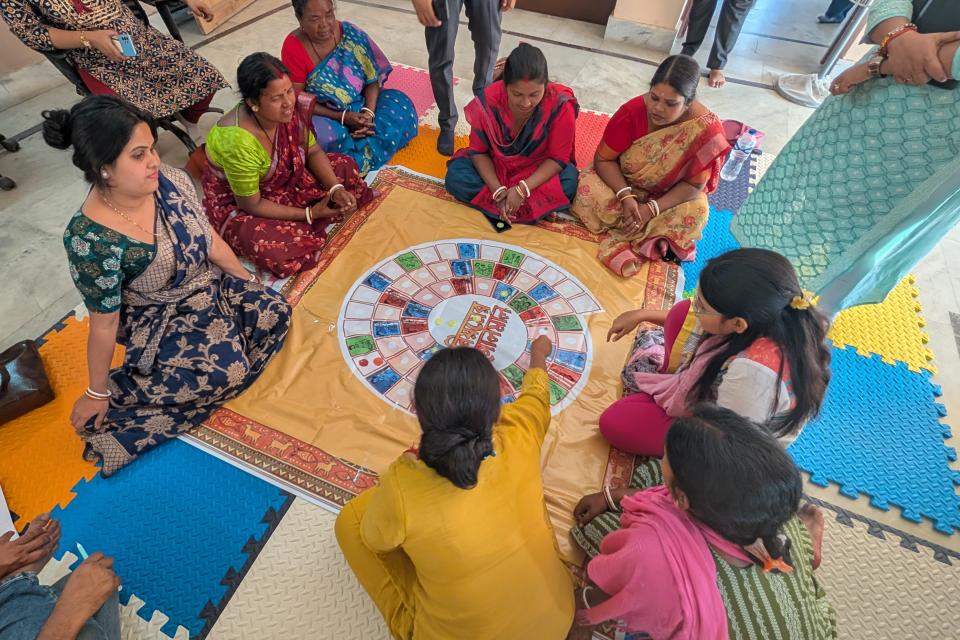
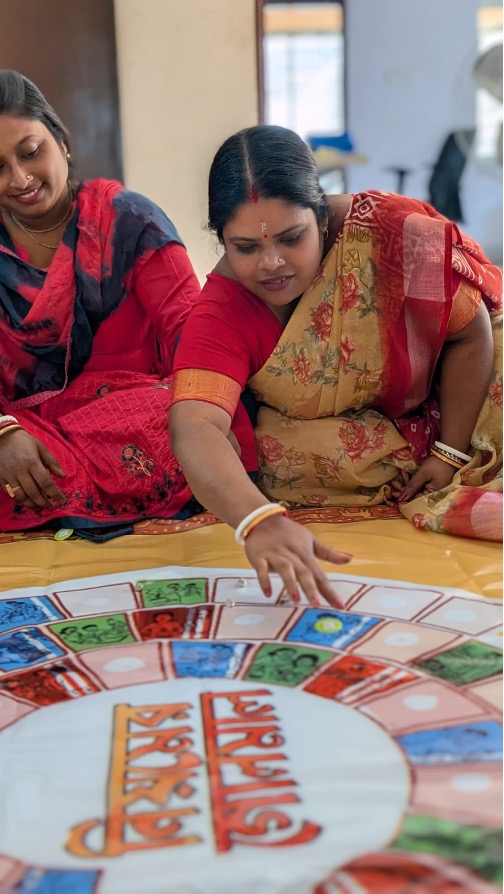
The second level is a board game- Niyomer Golmal or the ‘chaos of rules’. The same scenes — labour, mobility, care, conflict, companionship — appear on a large colour-coded board. Green is for enabling norms, blue for semi-restrictive ones, red for highly restrictive norms. Instead of dice, players use cowrie shells which they have always used.
The move from cards to a board alters the rhythm of the game. Rather than managing what one holds or discards, players advance piece by piece across a shared, visible terrain. Each move unfolds in public view. Progress is no longer about matching cards; it is about navigating a landscape structured by norms — advancing, pausing, or being held back along the way.
In everyday life, restrictive norms rarely appear as obstacles. Constraint feels natural. They operate quietly, shaping what feels possible or appropriate. As play unfolded, the patterned quality of constraints became visible. Those who landed repeatedly on red squares stalled while others advanced. Laughter mixed with frustration. Some players lingered over the images attached to red spaces, looking more closely. Stagnation was experienced before it was analysed.
Movement stalled not because of individual failure, but because of the logic of the system. The slowing was structural. What is ordinarily absorbed as “the way things are” was momentarily externalised — and made perceptible.
Suspending the ordinary
In many Indian rural contexts, card play is associated with men — with leisure, gambling, drinking, and time away from domestic work. Leisure itself is gendered - women’s time is expected to be productive and accountable. Cards do not easily belong to them.
At first, there was hesitation. Some handled the deck tentatively; others laughed self-consciously. The association lingered in the room.
Structured play creates a bounded space in which everyday expectations loosen. Norms do not disappear, but they are temporarily bracketed. Within this frame, participation can shift.
Gradually, the hesitation faded. Women shuffled more confidently, studied the illustrations closely, argued over moves, teased one another. A usually quiet participant laughed loudly each time she avoided landing on a red square. During the training-of-trainers session, younger women coached older ones. Authority moved situationally.
What was striking was not only the discussion of norms, but the reordering enacted through play itself. The game rearranged relations of age, voice, and entitlement to leisure. The board did not merely depict norms; it created moments in which they could be sidestepped.
Several women remarked, half playfully yet firmly, “From now on, even we will play cards.” Some said they were holding cards for the first time. Others had only seen men shuffle and deal. To handle the deck — small gestures — felt quietly transgressive. The act unsettled a local norm before any discussion began.
A game anthropology for Research and Development
When a group gathers around a board or a deck of cards, interaction changes. Conversation moves through rules, turns, prompts, and scenarios rather than direct confrontation. Authority resides in the procedure. A difficult point can be raised as a move in the game rather than as a personal accusation. Someone can pass a turn and still remain part of the exchange.
In this case, the game was not designed for participants — it was shaped with them. Women farmers suggested the name, debated the rules, and decided how the board should work. What should happen when someone lands on red? Should green give an extra move? How many turns should be lost? These discussions were lively and practical, with participants thinking about fairness, strategy, and how the game should flow.
A game anthropology -the discipline of understanding games as cultural artefact- directs attention to these interactional effects. Instead of asking what preferences a game reveals, it asks how structured play rearranges participation as it unfolds. Who speaks with less risk? How is disagreement expressed? What becomes sayable because it is attributed to a rule rather than to an individual?
In this sense, a game is a temporary arrangement of roles and constraints. Its rules delimit what can be done and said, but they also distribute voice differently. Participants test norms through scenarios rather than defend personal positions. Critique circulates without necessarily attaching blame. Reflection can occur without immediate self-disclosure.
For research and development practice, where discussions of norms often feel evaluative or morally charged, this matters. Games cannot remove power differences or guarantee change. But they can make it easier for people to speak, shift attention from individuals to broader patterns and encourage collective reflections. As feminist scholar Srilatha Batliwala argues, meaningful change often begins when women collectively encounter the norms shaping their lives and reflect on them together
Seen this way, games are more than tools for collecting information. They create a different kind of interaction—one where people can question, discuss, and experiment with social norms together
Related content